How to Turn Your LPR Audit Into a Content Machine That Actually Brings Calls
How to Turn Your LPR Audit Into a Content Machine That Actually Brings Calls

You know that sinking feeling. You’re staring at a blank content calendar, wondering what to write about this week. You need something that will actually work—not just another blog post that sits there, gathering digital dust. You need content that connects to real searches and turns into real calls.
If you’ve run an LPR Audit report, the solution is already in your hands. That report is more than just a list of fixes; it’s a direct line into the minds of your local customers. It tells you exactly what they are searching for and what your competitors are using to get their calls.
Instead of guessing what to post, you can build a strategic content engine. Let’s break down how to use your report to create a foolproof calendar and structure it on your website to make Google pay attention.
Your LPR Audit Report Is Your 12-Month Content Plan
Your audit isn't a one-and-done task. It’s a perpetual idea generator. Your “Competitor Gap Analysis” and “Missing Services” list reveal proven, high-intent search demand that you can tap into.
Here’s how to translate the data on your report into a structured plan for the next year:
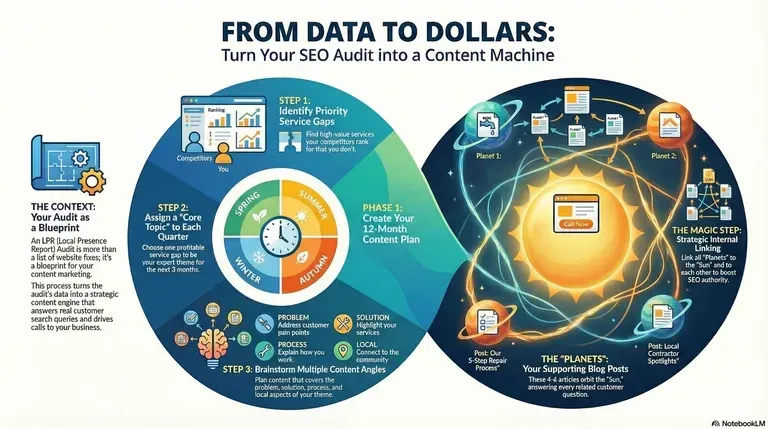
1. Identify Your Priority Service Gaps. Open your LPR Audit Excel file. Look at the list of 50, 100, or even 150+ services your competitors are listed for that you’re missing. Don’t feel overwhelmed. Pick 3-4 of these services that are most central to your business and most profitable. These are your Q1 topics.
2. Assign a “Core Topic” to Each Quarter. For a quarter, you are going to become the undeniable expert on that one missing service. If you’re a roofer and “Emergency Roof Repair” was a big gap, that’s your Q1 theme. “Gutter Installation & Repair” could be Q2.
3. Brainstorm Content Angles Around That Service. For each quarterly theme, brainstorm different content formats that answer every question a customer might have:
* The Problem: (“What counts as a roofing emergency?”)
* The Solution: (“Your step-by-step guide to emergency roof repair”)
* The Process: (“How to file an insurance claim for storm damage”)
* The Options: (“Temporary fixes for a leak before help arrives”)
* The Local Angle: (“Why [Your City] homes are prone to [specific damage]”)
* The Trust Builder: (A video tour of a recent emergency repair job)
Now you have a full quarter of content, all laser-focused on capturing traffic for a service you know people want. This isn't random blogging. It's strategic publishing.
Building Your "Mini Intent Cluster" on Your Website

Publishing the content isn't enough. You need to structure it on your website so Google understands you are the definitive source for this topic. This is where you build your "Mini Intent Cluster."
Think of it as creating a small, powerful solar system on your site:
* Your Service Page is the Sun: This is your main /services/emergency-roof-repair/ page. It's the center of gravity. It should be detailed, have clear calls to action (like "Call for 24/7 Service"), and contain the exact phrases from your LPR Audit's "Website Blueprint."
* Your Blog Posts & Videos are the Planets: These are the 4-6 pieces of content you created for the quarter. Each one orbits and supports the main service page by linking directly back to it.
How to Link It All Together (The Magic Step)
This is the crucial part that most businesses miss. You have to actively connect the dots for Google and your visitors.
* Every blog post you write for this cluster must contain a clear, contextual link to your main service page. Use descriptive anchor text like, “If you need immediate emergency roof repair, our team is available 24/7.”
* Your main service page should link out to these helpful blog posts. Add a section titled "Helpful Resources" or "Learn More About Emergency Repair" that lists the articles.
* Link related blog posts to each other. If you mention insurance in your "temporary fixes" article, link to your detailed "insurance claim guide."
This creates a semantic support mesh. It tells Google, "This website has a deep, organized hub of information about Emergency Roof Repair." This massively boosts your chances of ranking not just for one keyword, but for dozens of related searches.
Your Simple Action Plan to Start This Week
1. Open Your LPR Audit Report. Look at the "Missing Services" list. Circle the top 3.
2. Pick Your First Core Topic. Choose one for your first "mini cluster."
3. Create or Update Your Main Service Page. Ensure it perfectly matches your Google Business Profile service listing and includes the key phrases from your audit.
4. Write Your First Supporting Blog Post. Choose one angle from your brainstorm list. When you publish it, make sure it links to your main service page.
5. Repeat. Add another piece to the cluster next month.
By doing this, you stop guessing and start building. You turn a one-time audit into a system that fills your calendar with high-intent topics and structures your website to be a lead-generating authority.
Stop creating content that goes nowhere. Use the data you already have to create content that connects. Your phone will thank you.